Vacuum metallization,
decoration and finishing.
Plating, lasering, hot stamping, printing and spray painting all happen on our own floor — fewer vendors in the chain, tighter colour matching, and a shorter path from molded part to finished, packed product.
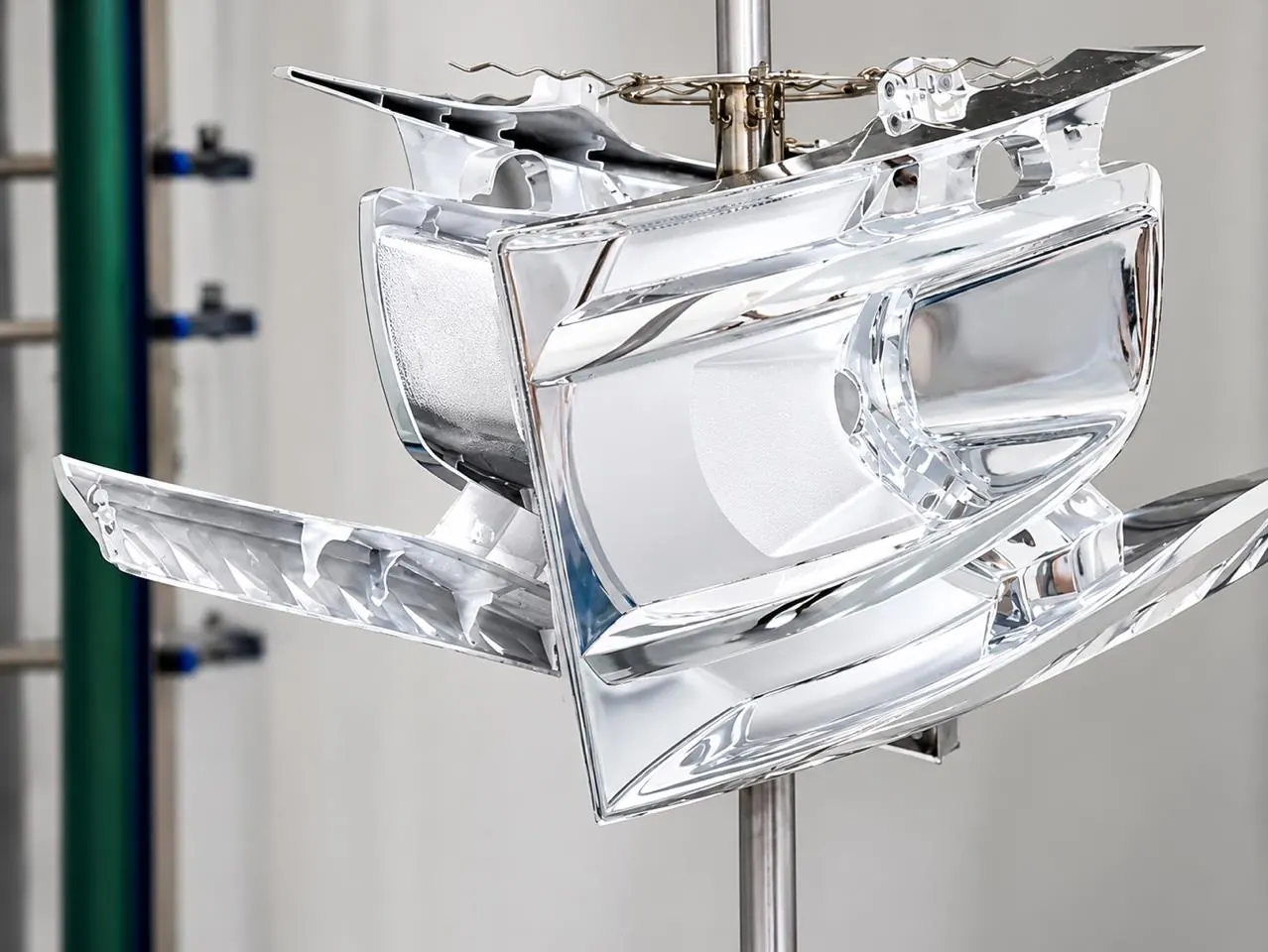
Every finish, inside the same building
Secondary processing is where brand-critical parts are usually lost. Sending a molded part out for plating or printing adds transit, adds a second quality system, and puts a supplier boundary in the middle of the one operation most likely to produce cosmetic rejects.
Finishing capability
- ✕Vacuum plating / metallization
- ✕Laser engraving & etching
- ✕Hot stamping
- ✕Silk screen & pad printing
- ✕Spray painting in a fully enclosed, dust-free room
- ✕Ultrasonic welding
Why it stays in-house
Colour and decoration matching is measured against the molded part, not a travelling sample. A shade drift that would take a week to diagnose across two companies is settled the same day.
Lead time compresses too: the gap between a part coming off the press and leaving the building packed is measured in process steps, not in shipments between vendors.
And when something does go wrong, accountability sits with one facility rather than dividing at a loading bay.
Finishing processes
Vacuum metallization
Two plating chambers for chrome and metallic effects.
Laser engraving & etching
Permanent marking, logos and serialization.
Hot stamping & silk screen
Pad printing and foiling for brand-critical decoration.
Spray painting
Fully enclosed, dust-free spray room.
Automotive lighting — chrome and lens components
An automotive headlight assembly combining a vacuum-metallized reflector with a moulded polycarbonate lens: two very different surface requirements on one part, produced and finished on the same site.
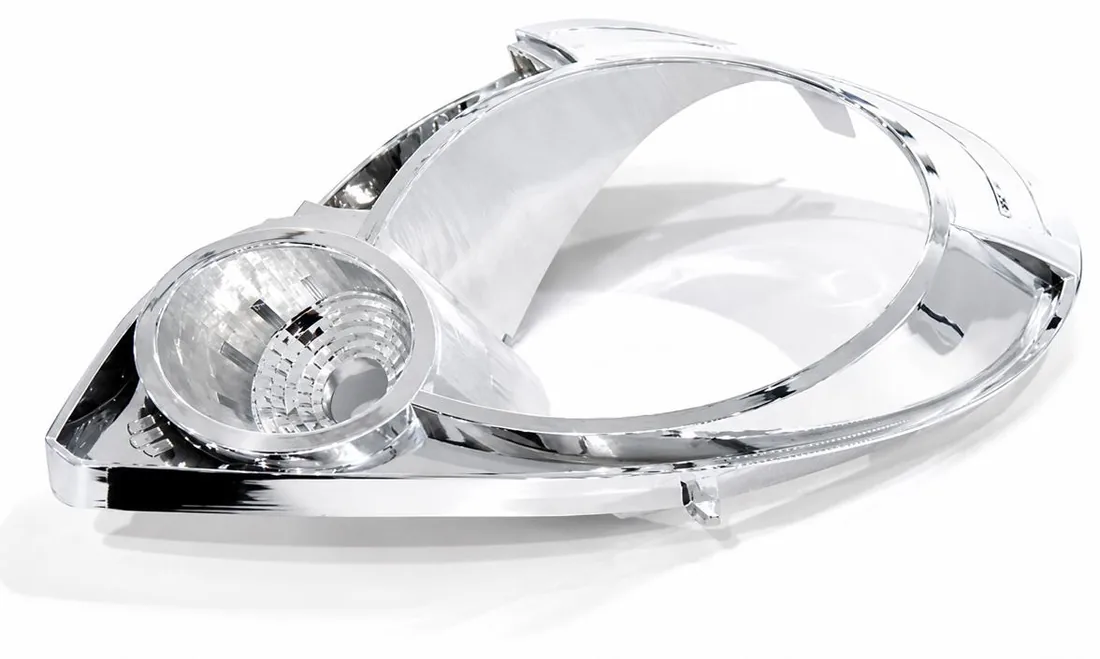
Automotive headlight
Automotive headlight with aluminum vacuum metallization.
- Primary material
- PC
- Wall thickness
- 2.5 mm
- Dimensions
- 51 × 26 × 12 cm
- Finish
- Vacuum plating
Finishing questions
What is vacuum metallization?
Metal — usually aluminium — is evaporated in a vacuum chamber and deposited onto the part as a thin, highly reflective film, then sealed with a topcoat. It gives a chrome or metallic appearance at a fraction of the weight and cost of plated metal, which is why it is standard for automotive reflectors and cosmetic trim. We run two plating chambers.
Can you match a specific colour or brand finish?
Colour and decoration matching is the main reason to keep finishing in-house. When molding and decoration sit in one building, a mismatch is corrected against the actual molded part rather than against a sample that travelled between two suppliers.
What decoration methods are available?
Vacuum metallization, laser engraving and etching, hot stamping, silk screen and pad printing, and spray painting in a fully enclosed dust-free room. Ultrasonic welding is available where decoration and assembly need to be sequenced together.
Is laser engraving permanent?
Yes. Laser engraving removes or alters the surface itself rather than adding a layer, so it does not wear off like printed marking. It suits logos, part numbers and serialization where traceability has to survive the product’s service life.
Why does a dust-free spray room matter?
On a painted cosmetic part, a single airborne particle landing in wet paint is a reject. An enclosed, filtered spray room is what makes a high-gloss painted finish economically viable at volume rather than a source of constant scrap.
Send us a part. We’ll come back with a route to production.
Attach a drawing, STEP file or reference photo. We’ll respond with feasibility, tooling approach and an indicative lead time.
Or email Noah.j@dapyparis.com